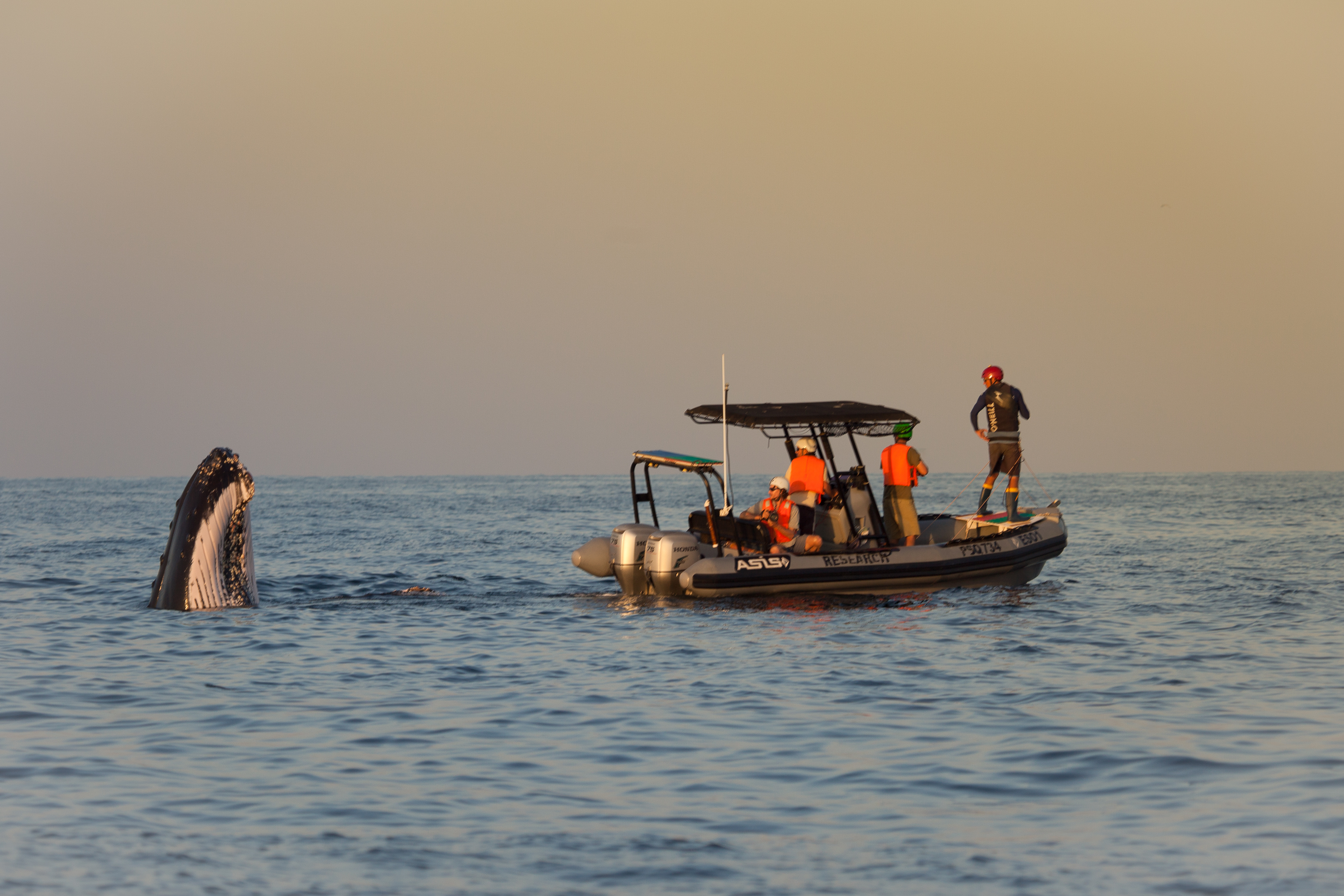
Fishermen in Pakistan free entangled humpback whale

[wpvideo cqHtvUsj]

Video of the entangled whale, that was freed by a WWF-Pakistsan trained captain of a tuna vessel.

The WWF-Pakistan led programme to train fishing captains in how to report whale sightings and free accidentally entangled wildlife from their nets is yielding more and  more valuable information and saving the lives of endangered whales.

On the morning of December 13th, a 10.5 m long Arabian Sea humpback whale was found entangled in a monofilament net that the Al-Mustafah fishing boat had set on the previous night.  Captain Nakhuda Sajan put out a call for help to nearby fishing vessels, and the tuna vessel, Al-Jihad, captained by Saeed Badsha, a WWF-Pakistan trained fisherman, immediately rushed to the scene and safely released the whale.

The WWF-Pakistan programme is led by ASWN members Rab Nawaz and Muhammad Moazzam Khan, Technical Advisor (Marine Fisheries), WWF-Pakistan and Chairman of Pakistan Whale and Dolphin Society.  In the past three  months alone, the programme has yielded 22 confirmed sightings of Arabian Sea humpback whales off the coast of Pakistan (involving an estimated 43 individual whales). It has also provided sightings of Bryde’s whales, and the release of a bottlenose dolphin and a turtle.

Prior to the launch of this programme, the only clues to the current distribution and population status of Arabian Sea humpback whales outside of Oman were the catch positions of 242 whales illegally hunted by the Soviets in the 1960’s.  Mapping the locations of these recent fishermen-reported sightings will help ASWN members determine where to focus future research efforts that will include photo-identification, genetic sampling, and possibly satellite tagging.   This research is urgently  needed to learn how the whales present off Pakistan are related to whales that have been studied off the coast of Oman over the past 16 years, and how  many whales are left after the intensive hunting by the Soviets.

The programme is well-publicized, and media coverage in various newspapers (such as the Pakistan Daily Times, and the International News) and television coverage is helping to increase awareness of Arabian Sea humpback whales and their conservation status.

The ASWN plans to organize regional capacity building meetings to replicate this successful programme in other parts of the Arabian Sea Humpback whale range.  Watch this space!

Arabian Sea humpback whales feature in Pakistan Daily Times

The locations of three recently reported humpback whale sightings in Pakistan, and a photograph taken by the fishing vessel captains who reported the sightings.  More details in the link to the Pakistan Daily Times newspaper article below.

Since 2014, WWF Pakistan has been leading a fisheries observer programme that trains fishing vessel captains to record and share their sightings of high conservation value marine wildlife, such as turtles and whales.  This month, vessel captains have reported a  number of sightings of Arabian Sea humpback whales, with some sightings being supported by photos and video.  This is an incredibly valuable source of data from a part of the Arabian Sea where we know whales were hunted in the 1960’s, but where no formal research has taken place since then to confirm their continued presence in the area.

These sightings featured in this article  in the Daily Times of Pakistan.  This press is great to raise awareness of Arabian Sea humpback whales and the threats they face in the region, and will hopefully encourage more fishing vessel captains and members of the public to record and report their whale sightings.  Kudos to ASWN  members, Moazzam Khan and Rab Nawaz for leading this successful programme and sharing its valuable results.

Additional press coverage included multiple spots on Pakistani TV news and:


Arabian Sea humpback whales are one of only four populations still considered Endangered under the United States revised Endangered Species Act listing.

The following statement was posted by WWF International:  and is copied here below:

Following an extensive review process that started in 2009 and was finalized in September 2016, the United States’ National Oceanic and Atmospheric Administration has revised the status of humpback whale populations around the world under the US Endangered Species Act (ESA).  The modified listing recognizes the Arabian Sea population as one of only four humpback whale populations around the globe that is not recovering from historical whaling, and is at high risk of extinction without serious conservation efforts.noaa-map-of-new-humpback-dpssMap showing the 14 humpback whale Distinct Population Segments (DPS) now recognized under the United States’ Endangered Species Act.  Of the four populations that remain Endangered, the Arabian Sea population (number 14 on this map), is considered the most distinct and the most likely to become extinct without conservation intervention.  Source: http://www.nmfs.noaa.gov/pr/species/mammals/whales/humpback-whale.html
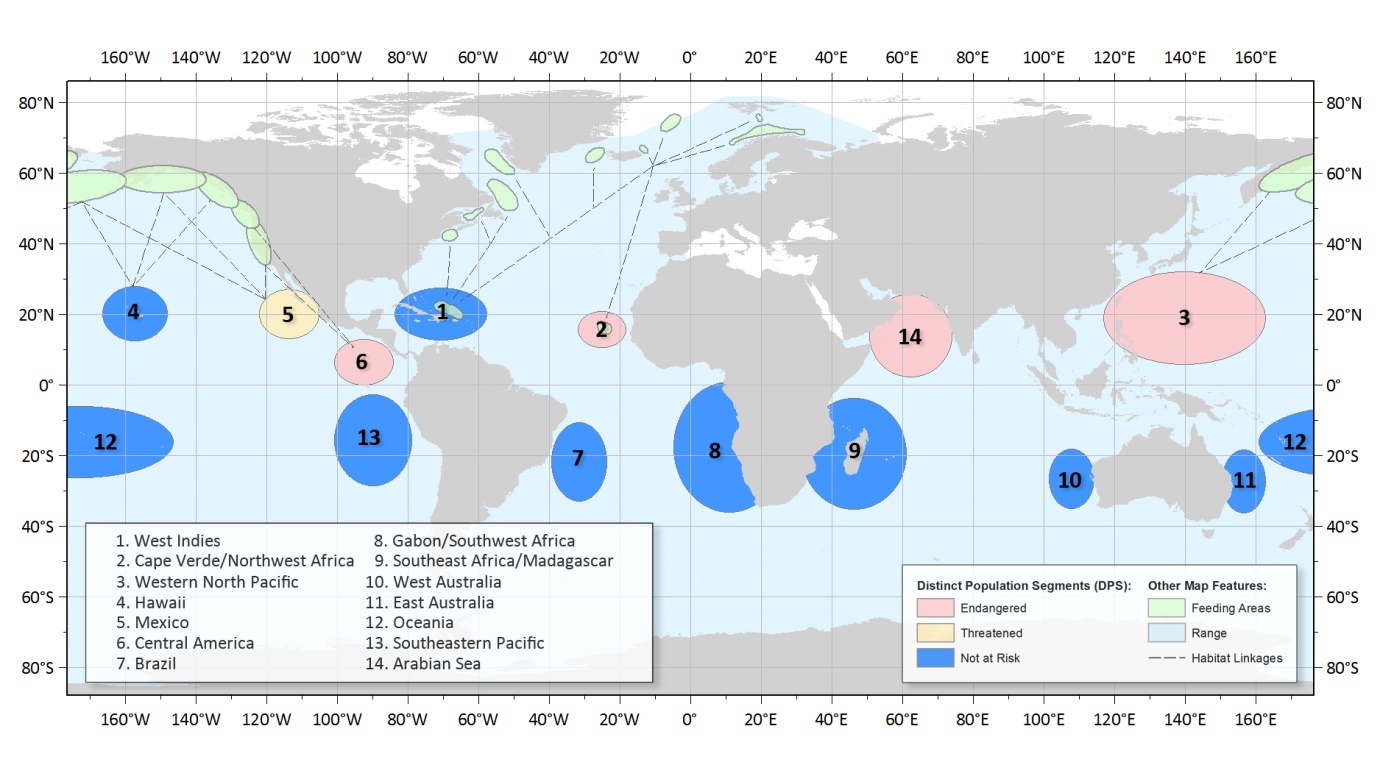
A Biological Review Team examined hundreds of scientific studies and reports that demonstrate how the majority of humpback whale populations around the world are increasing following the International Whaling Commission’s ban on commercial hunting of this species in 1966.  Careful consideration led to the designation of fourteen “Distinct Population Segments” (DPS), nine of which are no longer considered to be in immediate danger of extinction, and have thus been “de-listed”.  A DPS is treated equivalent to a species under the ESA.

The notice states: “The Arabian Sea DPS faces unique threats, given that the whales do not migrate, but instead feed and breed in the same, relatively constrained geographic location. Energy exploration and fishing gear entanglements are considered likely to seriously reduce the population’s size and/or growth rate, and disease, vessel collisions, and climate change  are likely to moderately reduce the population’s size or growth rate….. The…. Arabian Sea DPS [is] in the ‘at high risk of extinction’ category.”

However, five populations have not shown the same signs of increase toward recovery, and are still listed as Endangered or Threatened.  Of these, the Arabian Sea population is the smallest, most distinct, and most at risk.  Its range is believed to extend from the coasts of Yemen and Oman in the west to Iran, Pakistan and India in the east.

The Biological Review Team that conducted the 6-year long review process considered evidence from the Arabian Sea that includes information on illegal hunting of whales by Soviet whaling fleets in the 1960’s, fifteen years’ worth of dedicated whale research off the coast of Oman, and a few opportunistic sightings and strandings of whales along the coasts of Pakistan and India.  Data from Oman provide evidence that the population is extremely small, numbering fewer than 100 individuals, and confirm the Soviet whalers’ speculation that Arabian Sea humpback whales comprise the only non-migratory population of humpback whales in the world.  Genetic evidence shows the population to be distinct and no longer in breeding contact with any other humpback whale populations in the Indian Ocean.

These factors, coupled with ever-increasing threats from entanglement in fishing gear, strikes by vessels in some of the world’s busiest shipping lanes, and noise from shipping, coastal development and offshore oil and gas exploration, are cause for serious concern.  The population also has high levels of liver abnormalities and skin disease, which may render them more vulnerable to other diseases or stressors. Furthermore, this non-migratory population, restricted to the “cul de sac” of the Arabian Sea, has no alternative feeding or breeding grounds should climate change or an environmental disaster on the scale of the Deepwater Horizon irrevocably change the dynamics of their limited habitat.

engangled-whale-off-oman-2

Entangled humpback whale off the coast of Oman

While the Endangered Species Act most directly affects whales present within US waters, it also applies on the high seas to any vessels or persons under US jurisdiction.  The notice states that while the International Whaling Commission (IWC) and the Convention on International Trade in Endangered Species of Wild Fauna and Flora (CITES) provide significant protections to all large whales, there are no formalized governmental or inter-governmental conservation efforts for the Arabian Sea humpback whale.  To address the lack of coordinated effort to save this population from extinction, whale researchers and conservation organisations from Arabian Sea range states have joined together in the Arabian Sea Whale Network.  Very much a grass-roots initiative, this network strives to support whale research and conservation efforts in the region.  Together with the Wildlife Conservation Society (WCS), The Environment Society of Oman and the US Marine Mammal Commission, WWF has played a critical role in supporting the formation of this network.

Network members in Pakistan, India, Oman and Iran are conducting research to better describe the range and status of the population and working with local stakeholders to mitigate threats, but they lack sufficient funding.  As a result, we know almost nothing about the whales’ current distribution, numbers, or specific habitat needs in their suspected range outside of Oman. Funding is also needed at a regional level to support training and awareness-raising at all levels, and to better coordinate collaborative research and conservation work. Overall, without significant governmental efforts and stakeholder involvement to reduce the threat of whale entanglement in fishing gear along all the coastlines of its range and to address the risk of ship-strike in corridors of high shipping activity, the outlook for the Arabian Sea humpback whale population looks bleak.  Only through collaboration by governments, NGO’s, IGO’s, industry and other relevant stakeholders can we hope to overcome the odds, as has recently been demonstrated by the ongoing efforts to conserve gray whales in the western Pacific.

For more information, contact Arabian Sea Whale Network coordinator Gianna Minton  (gianna.minton@gmail.com) or look at our website:  https://arabianseawhalenetwork.org/

Arabian Sea Whale reports presented to the IWC in 2016

IWC-logo-White-Background-High-Res (Custom)

This year Arabian Sea whales made a strong showing at the meeting of the Scientific Committee of the International Whaling Commission.  The following documents were all presented in either the Southern Hemisphere  (SH) subcommittee, or the Human Induced Mortality (HIM) subcommittee.  Arabian Sea Humpback whales received a great deal of attention and discussion from both subcommittees, and the Scientific Committee reiterated its concern about the conservation status of this population, making  a number of formal recommendations for continued research and conservation measures in the region.

You can download the papers that were presented at this year’s meeting by clicking on the links below. They represent the most up-to-date information on Arabian Sea Whale populations.  However, please bear in mind that these reports do not carry the same status as papers published in peer-reviewed journals.  The official guidelines published on the IWC website for citing reports to the IWC SC meeting are as follows:

‘Papers submitted to the IWC Scientific Committee are produced to advance discussions within that Committee; they may be preliminary or exploratory. It is important that if you wish to cite this/a paper outside the context of an IWC meeting, you notify the author at least six weeks before it is cited to ensure that it has not been superseded or found to contain errors.’

SC_66b_SH_12_ASWN Newsletter

SC_66b_SH_14_ASWN Progress Update

SC_66b_SH_28_Satellite tagging and research Update Oman

SC_66b_SH_32_Preliminary report on Analysis of ASHW Acoustic data from Oman

SC_66b_HIM_10_whale and ship co-occurence in Arabian Sea

SC_66b_SH_34_Baleen whale records from Arabian Sea coast of India

Amaral et al. 2016_ Update on Genetic Analysis of ASHW samples from Oman _ working paper only

ASWN Logo and style guides

We are happy to share the final versions of the ASWN logo and style guides in English, Arabic and Farsi/Persian.  Please feel free to download the versions that you think you  might want to use, and if you don’t see your language there, please write to Oliver Kerr: Okerr@ewswwf.ae to request a version of the logo in your target language.

Style Guides:

ASWN_quickguide_Arabic

ASWN_quickguide_English

ASWN_quickguide_Farsi-Persian


Logo files in English:

ASWN_logo_EnglishASWN_logoBLANK

Logo files in Arabic:

Logo files in Farsi/Persian:

Successful satellite tagging survey in Oman

Half moon tag tracks

The Environment Society of Oman’s Renaissance Whale and Dolphin Project successfully tagged three humpback whales (named “Hamar An Nafur”, “Sifa” and “Yasser”) during their December expedition in the Gulf of Masirah. Previous research has established the significance of the area as important whale habitat, and the recent tagging efforts were launched to provide greater detail on their movements for conservation management purposes. . Stay tuned for more info and on the link below to follow daily updates of these magnificent whales on their ‘Giant Jouneys’: Link to Seaturtle.org tracks
ESO would like to thank their sponsors Renaissance Services and Port of Duqm for their support!

A successful entanglement and stranding response training workshop in Oman

At the end of October, 2015, a week-long workshop in Oman helped a variety of stakeholders learn about cetacean entanglement and stranding response.  Requested by the government of Oman, and delivered by the IWC in partnership with the Center for Coastal Studies, Provincetown USA, the workshop included classroom theory sessions as well as beach- and boat-based hands-on practice.  The workshop was almost too successful in its aim to provide hands-on training, as an unexpected mass stranding of 36 spinner dolphins was discovered in the middle of the training week, allowing for a lot of practice in data collection from carcasses.

Read more about the training event and see photos on this excellent summary on the IWC website:

(CCS) IWC summary of the training workshop

as well as the CMS website:

CMS report on the entanglement response workshop in Oman

oman entanglement training 4 - nov 15

Participants in the workshop receiving hands on boat-based disentanglement training practice. (Photo courtesy  of  IWC.)

Also check out the IWC-published best practice guidelines for large whale disentanglement:

IWC best practice guidelines for disentanglement of large whales

IOTC Training workshop in Oman – regional capacity building at work

cb_workshop_oman_0

A capacity building workshop to support the implementation of the Regional Observer Scheme of the Indian Ocean Tuna Commission (IOTC) was organized by the IOTC Secretariat in cooperation with the CMS Secretariat in Muscat from 18-22 October 2015. The workshop provided expert training to support the creation and implementation of observer schemes in Oman, Pakistan and Iran with a specific focus on gillnet fisheries. Given that accidental entanglement in fishing gear is one of the leading threats to Arabian Sea humpback whales and other whale populations in region, this effort represents a significant step toward threat mitigation. Read more about it on the CMS report of the workshop by clicking on the link below.

CMS report on IOTC training workshop in Oman