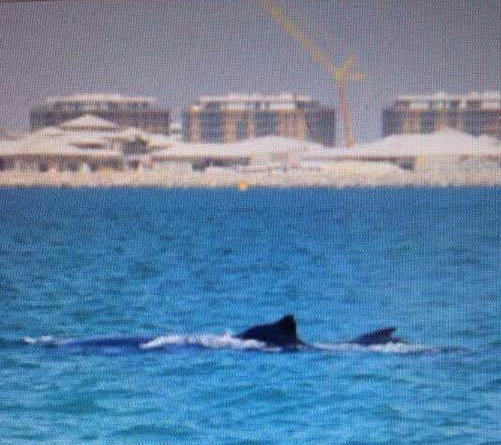
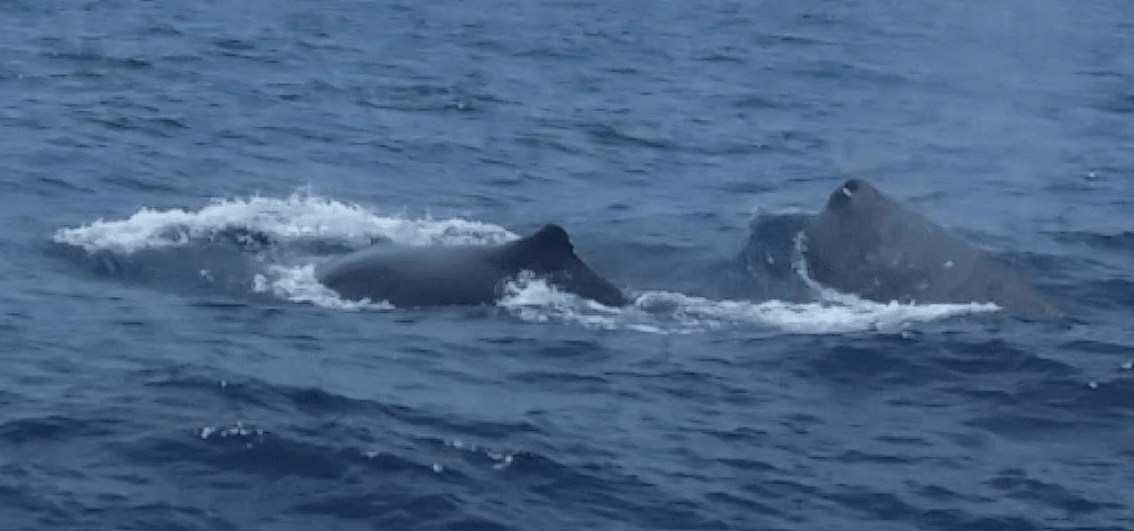
Humpback whale mother and calf observed off the coast of the United Arab Emirates

22365673_10159357834090696_8930018920120335409_n

22406376_10159357834115696_3676908839031920028_n-e1509266195178.jpg Humpback whale mother and calf observed off the coast of the United Arab Emirates

On October 9th 2017 a number of sightings of a mother and calf humpback whale were reported off the coast of Dubai (United Arab Emirates) to the UAE Dolphin Project (www.uaedolphinproject.org) and were shared with regional researchers and the general public (http://tinyurl.com/yb99vxtm). These sightings represent the first recent record of live humpback whales in the Gulf and are of great scientific interest for the conservation of the Arabian Humpback whale population. They support the hypothesis that the Gulf may be part of their natural home range and reconfirms the importance of regional collaboration on conservation efforts.
The Arabian Sea humpback whale population is considered Endangered according to the IUCN Red List (http://www.iucnredlist.org/details/132835/0). Unlike other humpback whale populations in the world, it does not undertake seasonal migrations, and recent genetic studies proved that it has been isolated from other populations in the Indian Ocean for an estimated 70,000 years. Its numbers are dwindling, with fewer than 100 individuals estimated to be present off the coast of Oman.  As such, conservation efforts are urgently needed.

Most of what we know about the population today is based on dedicated research on whales and dolphins off the Arabian Sea coast of Oman that has been conducted by the Environment Society of Oman (ESO). However, the home range of this population is still poorly defined. A number of sightings have been recently reported off the coast of Pakistan but little is known about the presence of this species in the Gulf . A recent publication examined 8 records of whales reported in the Gulf since the 19th Century and confirmed them to be humpback whales (link). The authors proposed that humpback whales may potentially be a regular occurrence in the Gulf, rather than just strays from the Arabian Sea.

Photographs of the mother whale’s dorsal fin were compared with photographs held in Oman Humpback Whale Photo-ID Catalogue which is curated by the ESO.  The mother was not matched to any of the whales identified off the coast of Oman, but researchers hope to find better quality photographs of the sighting that might show more detail and allow a more accurate match to be conducted.

The recent sightings of humpback whales in Dubai are of enormous interest and value, as they provide additional insight into humpback whale distribution in the Northern Indian Ocean and raise further questions about the importance of the Gulf region for this extremely rare population. It is also one of the very few occasions that a mother and a calf of this species have been observed in the region in the past 20 years.  Other sightings recently shared with researchers include that of a breaching Bryde’s whale in the Gulf.  These sightings which have been made available to researchers and government agencies through social media and photos and video gathered by interested members of the public demonstrate how important the Gulf may be for whales and dolphins, and how urgent it is that more dedicated and systematic research is conducted to describe their distribution and habitat needs in light of the many human activities in the region that may affect their well-being.

A number of initiatives have recently revealed valuable information on the distribution of cetaceans in UAE. These include the UAE Dolphin Project (www.uaedolphinproject.org), the  Fujairah Whale Research Project (www.fujairahwhales.com), which has documented sightings of species never before recorded in the UAE, such as striped dolphins and pantropical spotted dolphins, and the Environment Agency Abu Dhabi (Link).  However, more information is still needed to assess the status and identity of the local populations to support their conservation.
Text contributed by Ada Natoli and Marina Antonopoulou

Pre-print manuscript published on humpback whales in the Persian Gulf

three dorsals

Humpback whales off the coast of Oman (copyright Gianna Minton/ESO)

A pre-print manuscript is available collating and describing all the known records of humpback whales in the Persian Gulf.  The paper (see full link and abstract below), is the result of a collaborative effort between many researchers working in Iran and the rest of the region, and helps to clarify previously uncertain and/or anecdotal records that can now be properly cited in future literature and used to inform future cetacean research in the area.  Download the full paper by clicking on the link below:

Dakhteh, S. M. H., S. Ranjbar, M. Moazeni, N. Mohsenian, H. Delshab, H. Moshiri, S. M. B. Nabavi & K. Van Waerebeek (2017) Humpback whales of the Persian Gulf. bioRxiv, 13.

ABSTRACT
The humpback whale has long been considered a rare straggler into the Persian Gulf, however new evidence contradicts this concept. We here critically review published and new records for Megaptera novaeangliae occurrence in the Gulf for the period 1883-2017. Of eight authenticated records (6 specimens, 2 live-sightings), seven are contemporary cases while one is a mid-Holocene specimen from UAE. An additional four are possible but unsubstantiated reports. Four regional, current, range states are confirmed, i.e. Iran, Iraq, Kuwait and Qatar. Four of the five newly reported cases are from Iran’s coastal waters. We conclude that the Persian Gulf is part of the habitual range of the Arabian Sea humpback whale population, and has been since at least the mid-Holocene. It is unknown whether frequent passage occurs through the Strait of Hormuz or whether whales are (semi)resident. The low abundance of this endangered population and frequent deleterious anthropogenic events, particularly ship strikes and net entanglements, are cause for major concern. In view of its historical and taxonomic relevance, the formal description of Megaptera indica Gervais, 1883, from Iraq, now thought to be a subspecies M. novaeangliae indica, is here translated from French.

Sperm whales and blue whales sighted by fishermen off the coast of Pakistan

Blue Whale Pakistan 2017_09_11

Still image taken from video footage captured by WWF-Pakistan trained tuna fishing vessel skipper, Saeed Zaman off Churna Island, Balochistan on Monday, 11 .

We have featured a few earlier posts about the exciting reports of live whale sightings that are made by WWF-Pakistan’s crew-based observers working from fishing boats off the coast of Karachi and beyond.  As fishing resumes in the post-monsoon season, the first reports of 2017 are starting to arrive.  As of September 12th there have been 10 live whale sightings reported so far – one of them representing the first live sighting of sperm whales, and the other representing the first live sightings of blue whales ever recorded off the coast of Pakistan.

The two sperm whales were observed near Jiwani, Balochistan about 22 kilometers south of Gunz.  The fishing vessel, headed by Captain Mehar Gul, followed the two sperm whales for nearly 1.5 hours and recorded them on camera before they eventually disappeared into the sea.  The video footage was examined by WWF’s Moazzam Khan and other cetacean experts who confirmed the characteristic features and diving patterns of sperm whales.

vlcsnap-2017-09-14-18h17m40s577

A still image captured from video footage taken by Captain Mehar Gul who followed the two sperm whales and recorded them on camera. The image shows the characteristic dorsal fin (left) and square-shaped head and single blow-hole (right) of the two sperm whales.

The blue whale mother and calf pair were observed off Churna Island, Balochistan on Monday, 11 September 2017. WWF-Pakistan’s trained skipper, Saeed Zaman was fishing for tuna when he spotted a very large whale estimated at 17 metres in length, almost the same size of his boat.  The calf surfaced rarely so its size could not be assessed.  These whales were also captured on video, allowing confirmation of the species identification.

The presence of both of these species in Pakistani waters is not of great surprise, as they are found in the Sea of Oman and Arabian Sea coastal waters of Oman  and India and were both documented in the illegal soviet catches off the Arabian Sea coasts of Pakistan and India in the 1960’s.  There have also been some documented strandings and remains of both of these species in Pakistan over the years.

However, these recent sightings are of immense value as they demonstrate that these species are still present in Pakistani waters, and the sighting of a calf indicates that the animals may be reproducing in the area.  These sightings are remarkable for having been well documented by fishermen, at a relatively small cost compared to the costs associated with dedicated cetacean surveys.  The distribution of whale sightings that are accumulating through WWF’s unique programme should both inspire, and inform more targeted marine mammal research in the area, where surveys can be designed to target areas and times of year when fisheries-based observations were most frequent.

Items in the Pakistan media featuring these latest sightings can be found in:

SPERM WHALE SIGHTING:

The Dawn

The Daily Pakistan

Samaa TV Buzz

The International News

The Tribune

BLUE WHALE SIGHTING:

The Dawn

The News

The Tribune

New genetic comparison of all Southern Hemisphere humpback whales confirms unique status of Arabian Sea population

A recently published paper by ASWN member Howard Rosenbaum features a comparison of genetic samples collected from humpback whales off the coast of Oman with all other sampled populations in the Southern Hemisphere.  It is the largest study of its kind and helps illuminate unseen connections between populations.  The study of mitochondrial DNA confirms unique (most differentiated) population status for whales along Colombian coast and Arabian Sea.  Copied below is the text from the official press release by the Wildlife Conservation Society (WCS).
 
 
Image: Scientists used mitochondrial DNA from humpback whales in the Southern Hemisphere and the Arabian Sea to better understand how populations form. CREDIT: Tim Collins/WCS


NEW YORK (July 6, 2017) – Scientists conducting the first circum-global assessment of mitochondrial DNA variation in the Southern Hemisphere’s humpback whales (Megaptera novaeangliae) have found that whales faithfully returning to calving grounds year after year play a major role in how populations form, according to WCS (Wildlife Conservation Society), the American Museum of Natural History, and a number of other contributing organizations.

The research results build on previous regional studies of genetic diversity and will help scientists to better understand how humpback whale populations evolve over time and how to best advise international management authorities.

The paper titled “First Circumpolar Assessment of Southern Hemisphere Humpback Whale Mitochondrial Genetic Variation at Multiple Scales and Implications for Management” now appears in the online version of Endangered Species Research.

“Exploring the relationships of humpback whales around the Southern Hemisphere has been a massive undertaking requiring years of work and collaboration by experts from more than a dozen countries,” said Dr. Howard Rosenbaum, Director of WCS’s Ocean Giants Program and lead author on the study. “Our findings give us insights into how fidelity to breeding and feeding destinations persist over many generations, resulting in differences between whale populations, and why some populations are more genetically differentiated from the rest. From these efforts, we are in better positions to inform actions and policies that will help protect Southern Hemisphere humpback whales across their range, as well as in the Arabian Sea.”

In the largest study of its kind to date, researchers used mitochondrial DNA microsatellites from skin samples gathered from more than 3,000 individual humpback whales across the Southern Hemisphere and the Arabian Sea to examine how whale populations are related to one another, a question that is difficult to answer with direct observations of whales in their oceanic environment.

Overall, the study’s data from mitochondrial DNA—different from nuclear DNA in that it helps scientists trace maternal lineages—reveal that population structure in humpback whales is largely driven by female whales that return annually to the same breeding grounds and by the early experience of calves that accompany their mothers on their first round-trip migration to the feeding grounds. The persistence of return to these migratory destinations over generations, is known as ‘maternally directed site fidelity’. 

The occasional genetic interchange between populations also seemed to correlate with feeding grounds with high densities of krill, places where whales from different populations are likely to move vast distances and come into contact with other populations. The study also identified specific populations—those inhabiting the eastern South Pacific off of Colombia and a non-migratory population in the Arabian Sea—as more genetically distinct and isolated from other nearby populations and perhaps in need of additional management and conservation consideration. 

“Our increased understanding of how whale populations are structured can help governments and inter-governmental organizations like the International Whaling Commission improve management decisions in the future,” said Dr. C. Scott Baker of Oregon State University’s Marine Mammal Institute and a member of the South Pacific Whale Research Consortium that contributed to the study.

 
The humpback whale reaches a body length of 50 feet and, as a largely coastal species, is popular with whale watch operations around the world. Before receiving international protection in 1966, humpback whales were targeted by commercial whaling vessels that nearly drove the species into extinction. This included more than 45,000 humpback whales taken illegally by the Soviet Union after World War II. Current threats to humpback whales include ship strikes, underwater noise, pollution, and entanglement in fishing gear. 
 
These threats are particularly pertinent to humpback whales in the Arabian Sea, a genetically isolated population numbering fewer than 100 animals and currently listed on the IUCN’s Red List of Threatened Species as “Endangered.” WCS’s research is done in collaboration with a number of regional and local partners in the Arabian Sea working on advocacy and conservation, notably the Environment Society of Oman, among others.

The authors of the study are: Howard C. Rosenbaum of WCS and AMNH (American Museum of Natural History); Francine Kershaw of Columbia University and the Natural Resources Defense Council; Martín Mendez of WCS; Cristina Pomilla of AMNH and the Wellcome Trust Sanger Institute, United Kingdom; Matthew S. Leslie of AMNH and the Smithsonian Institution; Ken P. Findlay of the Cape Peninsula University of Technology, South Africa; Peter B. Best of the University of Pretoria, South Africa; Timothy Collins of WCS; Michel Vely of Association Megaptera, France; Marcia H. Engel of Projeto Baleia Jubarte/Instituto Baleia Jubarte, Brazil; Robert Baldwin of the Five Oceans Environmental Services LLC, Sultanate of Oman; Gianna Minton of Megaptera Marine Conservation, the Netherlands; Michael Meÿer of Oceans and Coasts, Department of Environmental Affairs, South Africa; Lilian Flórez-González of Fundación Yubarta, Colombia; M. Michael Poole of the South Pacific Whale Research Consortium, Cook Islands; Nan Hauser of the South Pacific Whale Research Consortium and Cook Islands Whale Research, Cook Islands; Claire Garrigue of the South Pacific Whale Research Consortium (Cook Islands) and Opération Cétacés (New Caledonia); Muriel Brasseur of Edith Cowan University, Australia; John Bannister of the Western Australian Museum; Megan Anderson of Southern Cross University, Australia; Carlos Olavarría of the University of Auckland (New Zealand) and Centro de Estudios Avanzados en Zonas Aridas (Chile); and C. Scott Baker of the South Pacific Whale Research Consortium (Cook Islands) and Oregon State University. 

 WCS (Wildlife Conservation Society)

MISSION: WCS saves wildlife and wild places worldwide through science, conservation action, education, and inspiring people to value nature. To achieve our mission, WCS, based at the Bronx Zoo, harnesses the power of its Global Conservation Program in nearly 60 nations and in all the world’s oceans and its five wildlife parks in New York City, visited by 4 million people annually. WCS combines its expertise in the field, zoos, and aquarium to achieve its conservation mission. Visit: newsroom.wcs.org Follow: @WCSNewsroom. For more information: 347-840-1242.

Astola Island declared Pakistan’s first Marine Protected Area

Pakistan Arabian-humpback-whale-at-Astola-Island

Arabian Sea humpback whale photographed by the WWF Pakistan team on 25 February 2007, approximately 2km west of Astola Island

Astola Island, located about 39 kilometres east of Pasni, Balochistan, in the Arabian Sea, has been declared the first dedicated Marine Protected Area (MPA) in Pakistan.  The island and it surrounding waters are known to provide important habitat to many marine species, including Arabian Sea humpback whales.

Covering an area of about 400 square kilometers, Astola is considered the largest island along the coast of Pakistan, and the Balochistan government, through a notification issued on Thursday declared it the first dedicated marine protected area in Pakistan’s history.

By declaring the Astola Island a marine protected area, Pakistan has started complying with the Aichi Target 11, which requires that at least 17 percent of terrestrial and inland water areas and 10 percent of coastal and marine areas be conserved are protected by 2020 .

WWF-Pakistan played a crucial role in providing the research and justification for this MPA, with over 25 years’ of studies and publications on the area’s biodiversity from 1990 to the present. WWF technical adviser and ASWN member Muhammad Moazzam Khan said Astola Island was a biodiversity hotspot hosting many species of marine and terrestrial animals and plants, including nesting green turtles, over 25 species of corals, and nesting colonies of the greater crested tern.  Endangered Arabian Sea humpback whales have also been observed in the waters off the island’s shores. “This will ensure conservation of these species whose population is drastically declining along the coast of Pakistan.  The declaration of Astola Island ensures that the biodiversity of the area is conserved, and use of deleterious fishing methods will be banned and recreational activities will be controlled,” ” Khan added.

ASWN member Rab Nawaz, WWF Pakistan Senior Director of Programmes, hailed the efforts of the secretary of the forest and wildlife department, Balochistan, and the minister and the secretary of the federal ministry of climate change for declaring Astola Island as a marine protected area. “WWF considers the declaration an effective step toward management of the marine protected area and protecting marine ecosystems, processes, habitats and species, which can contribute to the restoration and replenishment of resources for social, economic, and cultural enrichment.”

For more details on this exciting news, see the articles published in the Pakistan newspapers:  The News, and The Daily Times.

Pakistan nesting birds Astola Island

Greater crested terns nesting on Astola Island (Photo WWF Pakistan)

Exciting new discoveries in India and Sri Lanka”

Jayasayura_20170205_CO2_7D~0108-2_Oceanswell

Omura’s whale observed off the coast of Sri Lanka in February 2017. This is the first record of the species in Sri Lankan waters.

During recreational scuba dives over the course of two days in March 2017, Ajey Patil, a dive instructor in Goa (www.divegoa.com and divers Khush and Venkat from Barracuda Dive Club heard something new under water:  A series of strange and wonderful sounds that Ajey later described as “Honks, Grunts, Moo’s, and Machine gun rattling.”  It took him a few moments to realize that he was listening to the song of a male humpback whale. Not long before this event, ASWN member, Dipani Sutaria and her team of researchers had hosted a workshop in Goa to raise awareness of India’s whales and dolphins and their conservation needs.  Ajey had also purchased a Whale identification poster and guidebook to have on hand at his Dive shop.  When he heard this song, he realized that he had an opportunity to collect valuable data that Dipani and her colleagues could use to better understand these whales. Thinking quickly, he knelt on the sandy substrate of the sea, set his underwater camera to video mode and proceeded to record 20 minutes of humpback whale song.

While this recording is not of the same duration or quality as the acoustic data collected off the coast of Oman over the past several years, it provides valuable proof that humpback whales are present off the coast of Goa, indicating a possible season and location for more focused (acoustic) whale research in the future. Furthermore, since the ESO-Five Oceans research team was also collecting acoustic data from Oman in march 2017, it may be possible to compare the song from both areas and look for similarities as a potential indication of ongoing connections between the whales on either side of the Arabian Sea.

The network of eyes and ears that are now tuned to searching for whales along the West coast of India is growing, and we hope that more keen divers, boaters and/or fishermen will come forth with reports similar to Ajey’s in the months ahead.

In other exciting news, ASWN member Asha de Vos has published a paper on the First record of an Omura’s whale in Sri Lanka.  The sighting occurred on February 5th 2017 during a survey focusing on blue whale  photo-identification.  Multiple photos of the single individual were taken, and Asha was able to confirm the species ID through five important characteristics described in other papers from the region, including the recently published record off the coast of Iran and descriptions of the species as observed off the coast of Madagascar.

For a full press release on this exciting new paper click here.


Arabian Sea Whales at the 2017 meeting of the Scientific Committee of the International Whaling Commission

iwc-logo-blue-background-high-res-300x67

Last week several ASWN members had the opportunity to attend the Scientific Committee (SC) meeting of the International Whaling Commission (IWC) in Bled.  A wide range of papers was presented, highlighting the important work conducted by ASWN members and their colleagues over the past year, and leading to renewed IWC endorsement and encouragement of research and conservation efforts in the region. Those present at the meeting took advantage of the opportunity to hold an opportunistic ASWN meeting over a lunch break, and many more informal gatherings over tea, coffee and dinner helped to consolidate relationships and future plans.

Documents highlighting the Arabian Sea were mostly presented in the Comprehensive Management Plan (CMP) subcommittee, but additional documents were also presented in the Southern Hemisphere (SH) subcommittee and the Human Induced Mortality (HIM) subcommittee, where it was recommended that by-catch in the Western, Central and Northern Indian Ocean be included in the workplan for the 2018 SC meeting.

The Recommendations resulting from the CMP subcommittee were numerous, endorsing the work that has been conducted and making several recommendations for future research and collaboration in the region.  Watch this site for a full report of the SC meeting and a list of relevant recommendations when the report is finalized.  In the meantime, please click on the links below to download PDF’s of the documents relevant to Arabian Sea whales that were presented at this year’s IWC SC meeting:

SC_67A_CMP_03_rev1_Baleen whale records from India

SC_67A_CMP_05_Arabian Sea humpback and baleen whale sightings from Pakistan

SC_67A_CMP_07_rev1_ASWN progress report

SC_67A_CMP_12_Update on Humpback Whale research in Oman 

SC_67A_CMP_14_Presence of humpback whales in the Persian Gulf

SC_67A_CMP_15_Ensemble Niche modeling of humpback whale habitat in the Arabian Sea

SC_67A_HIM_03_AIS and modeling to mitigate ship strikes in Sri Lanka

SC_67A_HIM_11_Large Whale Entanglements from Sri Lanka

SC_67A_SH_13_Sperm whales in the Arabian Sea

The Arabian Sea Humpback Whale Infographic is ready for distribution!

ashw_infographic_021017_300

After months of planning, ASWN members have finalized an infographic designed to raise awareness of the unique nature of Arabian Sea Humpback whales and the urgent conservation challenges they face.  The infographic was made possible with financial support from the Emirates Wildlife Society-WWF, and was designed by Agenda 28 in consultation with all ASWN members.

The infographic is available in several formats:

The designers have also been generous enough to share the adobe illustrator files with us.  If any ASWN members would like access to these  in order to create versions of the infographic in a different target language, please contact Gianna Minton – gianna.minton@gmail.com, and we will  provide a google drive link for download.

We hope that members will be able to share this with many different types of stakeholders – including government agencies responsible for conservation management, fisheries managers, port authorities and other industries that impact the marine environment, NGO’s, schools, and many others.


A focus on ship strikes and whales in the Arabian Sea

Two recent publications highlight the risk of ship strikes to Arabian Sea whale populations.

spermwhale-shipscar

Sperm whale with severe damage incurred by ship propellers. Photo courtesy of Chris Johnson, WWF Australia

The first is a fact sheet, hot off the press from WWF International.  It draws on the International Whaling Commission’s Strategic  Plan to Mitigate the Impacts of Ship Strikes on Cetaceans, and highlights 10 key areas where the overlap of heavy shipping traffic and whale occurrence leads to a high risk to the whale populations in question.  The document draws attention to Arabian Sea humpback whales, and makes a number of recommendations for mitigation measures.  We hope that this can be a useful tool for ASWN members to use in raising awareness of the risk of ship strikes to ASHW and other Arabian Sea whale populations, and working with industry and government to help mitigate this threat.

The second is a paper titled Predicting cetacean distributions in data poor marine ecosystems that describes how 12 years of data on blue whale distribution in relation to oceanographic features off of California can be used to predict blue whale distribution in the Northern Indian Ocean.  The paper then discusses how this can be used to develop effective mitigation of ship strikes and other threats in the NIO.  Text from the press release linked to this paper is pasted below.

For  more information on ship strikes and cetaceans, please also look at the IWC website focusing on this issue.

Data on Blue Whales off California Helps Protect their Distant Relatives

 Research identifies blue whale habitat in the Northern Indian Ocean

Scientists know a great deal about blue whales off California, where the endangered species has been studied for decades.

But they know far less about blue whales in the Northern Indian Ocean, where ships strike and kill some of the largest animals on Earth.

Now a research team has found a way to translate their knowledge of blue whales off California and in the eastern tropical Pacific Ocean to the other side of the world, revealing those areas of the Northern Indian Ocean where whales are likely to be encountered. The team of scientists from NOAA Fisheries and the Sri Lankan Blue Whale Project published the findings this week in the journal Diversity and Distributions.

The Scientific Committee of the International Whaling Commission included the results of the study when assessing a shift in busy shipping lanes off the south coast of Sri Lanka that will reduce the danger to whales in an important feeding area.

“Small changes in shipping routes can be a very effective way to address a serious conservation issue with minimal inconvenience to the shipping industry, but rely on a good understanding of the relationship between whale distribution and habitat,” said Russell Leaper, a member of the Scientific Committee. “This study makes an important contribution towards that understanding.”

To meet requirements of the U.S. Marine Mammal Protection Act, NOAA Fisheries regularly conducts marine mammal and ecosystem assessment surveys. Surveys off the U.S. West Coast and in the eastern tropical Pacific have shown that the upwelling of deep ocean water rich in nutrients supports dense patches of krill that blue whales feed on.  This information has proven critical in addressing the emerging problem of ships striking blue whales, and has informed the management of ship traffic to and from the busy ports of Los Angeles and Long Beach to mitigate this problem.

“We are fortunate in the United States to have some of the best marine mammal data sets in the world,” said Jessica Redfern, a research scientist at NOAA Fisheries Southwest Fisheries Science Center in La Jolla, Calif., and lead author of the new study. “It was exciting to explore how we could use these data sets to aid conservation efforts in parts of the world where few data exist.”

The research developed computer models of blue whale habitat off the U.S. West Coast and in the eastern tropical Pacific, including upwelling and underwater topography that affects areas of krill concentration. The models then identified similar upwelling and feeding regions in the Northern Indian Ocean that are also likely to be important habitat for the endangered species.

“The Sri Lankan Blue Whale Project has spear-headed efforts to draw attention to and mitigate the risk of ships striking blue whales in Sri Lankan waters. To best protect this species in this data-limited region, it is essential to adapt approaches developed in other parts of the world. Our collaboration achieves just that,” said Asha de Vos, founder of the Sri Lankan Blue Whale Project and a coauthor on the study.

The Northern Indian Ocean and its inhabitants have not been surveyed to the same extent as the eastern Pacific Ocean, and much of the information about whale distributions comes from Soviet whaling several decades ago. However, the model results matched up well with the limited information available, the scientists reported.

The model suggests that the distribution of blue whales in the Northern Indian Ocean may shift seasonally, following their food as monsoon climate patterns alter the most productive habitat. The scientists concluded that research and monitoring is critical in the areas identified as blue whale habitat in the Northern Indian Ocean because many of these areas overlap with some of the busiest shipping routes in the world.

“Marine mammals face threats from human activities in most of the world’s oceans, but we lack the data needed to address these threats in many areas,” Redfern said.  “The data collected aboard our surveys allow us to predict species habitat in other parts of the world.  Understanding species habitat allows us to address conservation problems that are often unexpected and critical to maintaining healthy populations.”

Read the publication:

Redfern et al., 2017. Predicting cetacean distributions in data-poor marine ecosystems. Diversity and Distributions Diversity and Distributions, 1– 15. 

Learn more:

Cetacean Habitat and Risk Assessment Program, Marine Mammal and Turtle Division, Southwest Fisheries Science Center

 

New papers highlight the unique and vulnerable status of Arabian Sea humpback whales and the results of satellite tagging of whales in the Indian Ocean

kershaw-molecular-ecology-figure

Figure from Kershaw et al. 2017 demonstrating how Arabian Sea humpback whales were the  most genetically differentiated among the 7 breeding stocks sampled in the study.

Recently two scientific papers have been published that are of great value to our understanding of humpback whales in the Indian Ocean and Arabian Sea.  The first is a review of 3575 genetic samples collected from seven breeding stocks of humpback whales in the South Atlantic and Indian Oceans.  The study titled “Multiple processes drive genetic structure of humpback whale (Megaptera novaeangliae) populations across spatial scales” was published in Molecular Ecology.   One of the largest genetic studies ever conducted on humpback whales for the purpose of clarifying management decisions, it revealed more connectivity between the breeding stocks on the east and west sides of the African continent than expected.  Conversely. the results indicate that the Arabian Sea humpback whale population (ASHW) is the most highly genetically differentiated across all indices and partitions.  The paper uses samples collected off the coast of Oman in 2001 and 2002, and places them in a wider context than some of the previously published papers using these same samples.  The wider comparison confirms the unique and precarious nature of Arabian Sea humpback whales, and the authors recommend that the small population numbering fewer than 200 whales be made a conservation priority. The paper has been highlighted in  Science Daily  and Tech Times.   A full PDF of the paper can be downloaded here.

picture1


Figure from Cerchio et al 2016, showing tracks of humpback whales satellite tagged off two sites in Madagascar. Note the unexpected movement of one whale to a position north of the Equator off the coast of Somalia.


The second paper of note is titled “Satellite telemetry of humpback whales off Madagascar reveals insights on breeding behavior and long-range movements within the southwest Indian Ocean“.  Published in the Marine Ecology Progress Series, it reports on the results of  23 humpback whales that were satellite-tagged off the northeast and southwest coasts of Madagascar during peak breeding season.  The study reveals interesting sex differences in the behaviour of tracked whales, and indicates that there may be less mixing between the two study sites in Madagascar than would previously have been assumed. Of particular interest for the ASWN, is the track of one individual that moved north from the tagging site off Madagascar, crossing the equator and reaching the coast of Somalia before the tag stopped transmitting at 2° 59.9’ N. During 32 days the male whale covered over 2800 km (over 3120 km of trackline).  Given the genetic evidence showing a lack of mixing between humpback whales in the Southern Indian Ocean  and the Arabian Sea, the authors suggest that this whale may be a “vagrant” or that its movements may represent a new wave of northward exploration and possible expansion taking place as Southern Hemisphere populations increase following the cessation of whaling. A full PDF of the paper can be downloaded here.